Lake Bunyonyi is clear and calm this morning. It is reflecting the green of the hills, the blue of the mountains and the white of clouds to create an illusion not unlike a glass marble, all the colors colliding together in the middle. It's a perfect morning to sit and write.
Yesterday, Tavia and I went into town to visit Dr. Catherine Apio, Head of the Private Wing at the Kabale Regional Referral Hospital. We brought along Thomas, one of the Entusi staff, because he wanted Catherine to look at his three year old son, Travis. Travis was burned on his chest by hot water about a year and a half ago and Thomas was concerned about the scar and Travis's itching of the scar. I don't know too much on the medical side of things, but I told Thomas that it didn't look infected, and that it was raised and large because it is what is called a keloid. He hadn't heard this term before. We took Travis in to see Dr. Apio and she told him the same thing, prescribing hydrocortison for the itching and to prevent infection. With time, she said, the keloid may reduce in size, but Thomas was surprised to learn that Travis would have a scar his whole life. In addition to giving Thomas medical advice about Travis, Catherine also offered advice to Thomas and his wife about their family and their lives. "When your husband comes home from work, have him do the dishes and clean the house. No one ever died, no one ever lost a hand from doing the dishes" she said (I liked her more and more as she spoke). She continued that the Rukiga men (the tribe here in Southern Uganda) drink too much and don't work to support their children or their families. She said she has been surprised to see how much and often the men "booze" here. But, she told Thomas that because he is employed by Professor Jamie and because he works at Entusi, he is doing a good thing for himself, his family, and his community. Interestingly, Thomas seemed surprised to hear about the boozing and the lack of work done by the Rukiga men. Certainly he is surrounded by hard workers, here. But according to Catherine, that is not the general culture.
After Thomas left, we sat in the clinician room with Catherine as she saw a few patients. She counsels everyone in the same way she counseled Thomas. One schoolgirl she saw only knew how to speak Lachiga and Catherine asked her why this is. Catherine says she is always surprised to hear the answer: that they are comfortable here, will never go anywhere outside of Kabale, so there's no reason to learn English. Catherine tries to explain that there is a whole world outside of Kabale, and the importance of learning outside of what you can see. How true that is for everyone. Something else that is different about Catherine (besides speaking loudly about what is on her mind) is that she tries to explain to her patients what condition or affliction they have, what she is going to test them for, and what they should continue to do about it. This is not a common medical practice. She says she sees patients all the time who were prescribed something by a doctor, but they don't know what medication it is or why they are taking it. One woman came in with a headache, nausea and vomiting, saying she had been to her local clinic but that she still didn't feel better. Catherine asked her to show us the medicine the clinic had prescribed and it turned out to be a multivitamin. Catherine told her those were useless for her and to give them to her children. She then sent her for testing for typhoid and malaria. Another man came in (was carried in more like it) and had extremely labored breathing, a severe cough and looked like he was in intense pain. Immediately when I saw him I thought his symptoms looked familiar. Sue enough, Catherine told us she thought he had aspirational pneumonia and she was going to admit him. Unfortunately, he was also a seropositive individual on ARVs and diabetic. They gave him some pain medicine and admitted him. It didn't look as though the pain medicine had helped at all. I thought of my experience in the hospital with pneumonia back in December, and can't imagine that I would have survived without the intense medical care I received. Let alone to be HIV positive as well.
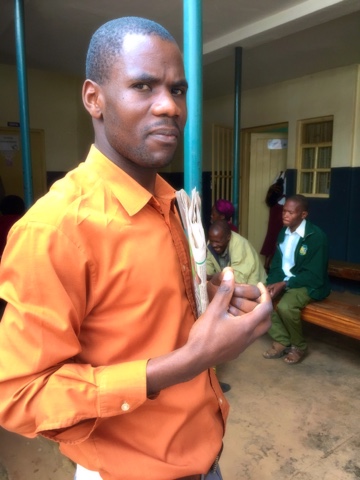
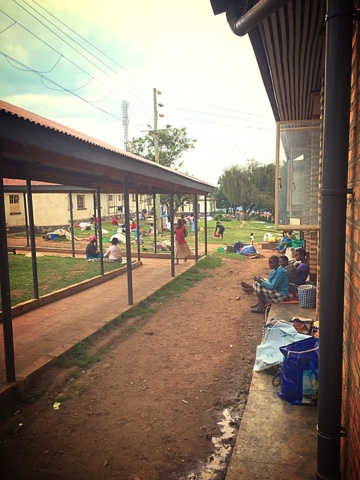
Following a few cases, Catherine started us on a tour of the hospital. We started at administration. The vision of the Kabale Hospital is "a center of excellence providing a high quality, general and specialized health services for a healthy and productive population in Kable region." We first toured the public part of the hospital, led by a man named Thursday, beginning in the dental ward. I was surprised by how many people were waiting in line for dental care. There must have been at least 30: men, women, and children. We entered the clinical room and found that there were three rooms with chairs for dental work, one dentist, and a few people who looked like assistants and students. They see a lot of gum disease and tooth decay, the dentist told us. Many people do not brush their teeth at all, many use a stick only. I watched as they pulled a tooth from an elderly woman in the next room. Yanked a tooth is more accurate. She had her eyes winced in pain as they twisted it out of her mouth. As soon as they got it out they had her up, blood on her chin, cotton in her mouth, and on her way out the door. She stumbled a bit as she tried to steady herself getting out of the chair, but just moved out of the clinic and on her with her day. What must it be like to have that kind of pain be a part of your daily existence. From the dental clinic we saw wound care, injections, the pharmacy, safe male circumcision, and HIV testing and counseling- all on the public side. Males are encouraged to get circumcised from age 15 to 49 to prevent the spread of HIV and other STIs. Culturally, they don't believe in circumcising babies- a lack of education about the spread of HIV also likely contributes to this. They had one room where they perform the procedure, and it looked like it was both a procedure room and a storage closet. Boxes everywhere with only a small partition for privacy.
The lines for every ward were very long and it looked like people knew they would be waiting for a while. Catherine was great because she asked lots of questions and seemed like she was learning more about the public side of the hospital than she had before. She's only been on the private side in Kabale for about two months. It seems as though there is very little interaction between the private and public side of the hospital, as she had to introduced herself to everyone we met. After we saw the departments in the medical ward, Catherine took us to the HIV counseling and treatment center. Patients will first meet with a counselor who triages their care and decides where they need to go next: pharmacy, clinician, blood testing, etc. They do CD4, CBC, and viral load testing. There is also a research center where they are conducting a project to determine if nurses should be considered qualified to distribute ARVs. There simply aren't enough doctors, particularly in the regions that are far away from hospitals and Health Center IVs to care for seropositive individuals and monitor their ARVs. We learned about the difficulties of drug adherence and also of simply getting people tested. Many are too afraid and would simply rather not know their status.
After we toured the HIV wing, Catherine left us in the care of Sister Jacqueline, who is the head nurse for the private wing. She took us to the eye clinic and we spoke with the doctor there for quite a while. He told us that nutritional deficiencies cause a number of eye problems, and they also see a lot of infection, glaucoma and cataracts. Many people also suffer consequences after they use local remedies and herbs for their eye problems. Jacqueline then took us to her office where she fed us tea, a banana, and these sesame balls that sort of resemble bird food but taste delicious (especially when dipped in peanut butter, we later discovered). Jacqueline is the epitome of what you imagine a nurse to be: she's strong, confident, takes charge, and is also caring, loving, and concerned with everyone else around her. She made sure we properly hydrated and then we continued our tour. We saw the records department where they are attempting to reorganize everything. There were files and binders EVERYWHERE. It looks like they are making good progress on their filing project, but as everything is written by hand, the paperwork is absolutely out of control. We then saw the public maternity wing, pediatric wing, immunization wing, gynecology wing, TB wing, and surgical wing. The difference between the private and public side is vast. There were so many children in the pediatric wing that some children and babies were placed on blankets underneath cots with other children. And then parents and relatives were sort of piled up in between these cots. Jacqueline told me that when they reach capacity they simply have to turn children away. How horrible that would be. Especially if you had traveled a long distance and spent a lot of money to see a medical professional, which is sometimes next to impossible, just to be turned away. We saw one little girl getting a blood transfusion right in the middle of the room. She was sitting up drinking some milk, and I assumed she was about 2 years old. Jacqueline informed us that she was here for malnutrition and anemia, and was actually 5 years old. The pediatric wing was difficult to see. All of the public wings were difficult to see, really. They are doing some really good work, but people are often not receiving adequate care. Mothers who give birth are given 24 hours in the wing and then they have to leave. It's just enough time, the head nurse told us, to ensure they get some food and know how to breast feed. We headed back to the private wing, and Catherine took us around to show us the difference and to ask for our input regarding some ideas she has for improvement. Catherine is full of some amazing ideas, and she's not afraid to tell anyone who will listen. Actually, she's not afraid to tell anyone whether they are listening or not. We found out it costs 60,000 USH (Ugandan shillings) to deliver a baby in the private wing with no complications. That's about $20. The private wing has three different room types: private room, self-contained and executive suite. The private rooms have a shared bathroom with the rest of the wing, self-contained has its own bathroom, and the suites have a bathroom, wardrobe, and small private balcony. Catherine is also working on getting TVs in the suites. Again, the differences between the two sides (which, by the way, are only about 100 feet apart) are drastic. We learned that on the private side patients and families must sometimes bribe the doctors to receive the care that they need.
It was a very full day. We saw so many things, met so many people. We were definitely ready to be home by the end of the day. On the way back to Entusi, we chatted with Thomas about his family and his life. In Uganda, dowries are still required before marriage, so he was explaining to us how he saved up 2 million Ugandan Shillings to give to his wife's parents before they were married. I asked him about this, to explain how he felt about it. He told me that you can't just go take a daughter from a family. You have to pay for her. Offer something. He asked me how we do marriage in the United States, if dowries are still accepted. We told him no. He said he thinks the culture is changing in Uganda, too. But it's no wonder women are treated as they are in Uganda when they are bought and sold like a commodity. Many of the women at the retreat told us how there was no celebration when they were born, how there was disappointment. How they were not allowed to go to school: "You are going to become a mother, and you don't need education for that." These women had to fight to receive a basic education. And had to fight more to receive education at a university, to find a job, to be taken seriously.
And yet.
We consider ourselves so far "advanced" in the United States when it comes to gender equality, so far beyond this, and in many ways we are. But in many ways still we are in the same. There is an underlying belief that women are worth less than men. There is a belief in the exchange of a woman from her parent's house to her husband's house. In a transfer of her identity from her father's name to her husband's. There is a belief that women are only capable of becoming mothers and nothing else, and if they become mothers AND something else, then they are therefore not good mothers. There is a belief that women's sexuality belongs to men. And that if she "gives it up" she is a slut, if she "protects it" she is a prude. As if it is something that can be given away or protected. There is a belief that if she is too powerful, too loud, takes up too much space, she is "bossy," a "bitch." There is a belief that a woman's body does not belong to herself. That her body exists and her choices can only be made within the political and social context that men in power allow. There is a belief that women and men have different inherent traits, and thus subsequently different roles to fulfill within that political and social context. Differing from these traits and roles is costly: for both men and women. We have certainly come a long way for women in the United States. For non-heterosexual, non cis-gender, non-white, non-male, non-Christian, non-conforming, non-silent people. But we have to be careful before giving ourselves a self-congratulatory pat on the back. It is important to look back and remember how far we've come, but we must also simultaneously be looking forward at how far we still have to go.